A Brief History of the Anglo-American Legal System … and a Bit More
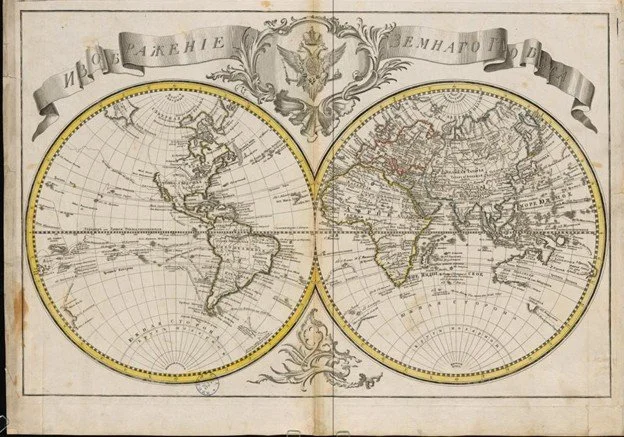
Izobrazhenie zemnogo globusa [translated as Representation of the Terrestrial Globe] Map from the Russian State Library, Saint Petersburg, Russia: [publisher not identified] Library 1750-1759. Reproduced from the collection of the Geography & Map Division, Library of Congress, Washington, D.C. https://www.loc.gov/resource/gdclccn.218694073/.
Martin A. Frey, Professor Emeritus
The University of Tulsa College of Law
© Martin A. Frey, All Rights Reserved. Educational use permitted with attribution.
43 Roman legions under Claudius moved north from France across the channel to an unnamed island and they pushed north conquering a number of Celtic tribes. At that time, the population of the island was one to two million. The Celtic tribes were spread around the island living largely a rural life with hillforts, farmsteads, and tribal centers.
The Romans named the island Britannia. The island became a province of the Roman Empire and the Romans began building outposts.
London did not exist as a city before the Romans. Founded in the late 40s, Londinium became the first practical crossing point of the River Thames and was ideal for trade, roads, and administration. By the 60s, Londinium was a significant commercial town, large enough to be destroyed and rebuilt after Boudica’s revolt, 60-61.
Between 122 and 128 CE, the Romans built a northern boundary that became known as Hadrian’s wall. The wall regulated movement, trade, and taxation. Substantial stretches of the wall still survive, especially foundations and reconstructed sections.
330 As the Roman Empire was gradually splitting into eastern and western halves, Constantine refounded Constantinople in 330, formerly Byzantium, as the imperial capital of the eastern half, marking the effective beginning of the Byzantine Empire as the dominant eastern Mediterranean power.
410 Over time, the Roman Empire declined and the Roman administrative rule of Britannia came to an end.
400s & 500s As the Romans were leaving, the Angles and Saxons were arriving from northern Germany and the Jutes from southern Denmark. The Angles settled in East Anglia in eastern England, Mercia in central England, and North Umbria in northern England. The Saxons settled in Wessex, Sussex, Essex in southern England. The Jutes settled in Kent and the Isle of Wight. Together, they laid the foundation for the English language, early English kingship, and the political map of England.
Between 500 and 700 The name England emerged from Old English, Englaland — “Land of the Angles.” Englaland became “England” during the 800s and 900s.
711 Umayya-led Muslim forces crossed from North Africa at Gibraltar and began their conquest of the Iberian Peninsula. Control was rapid. Within a decade, they controlled most of the peninsula.
793 The Vikings staged their first raids on the island. Between 800 and 900, they exerted constant pressure on the island.
By 800 England was not a single kingdom but a patchwork of competing Anglo-Saxon kingships. Kingships were personal.
871-899 Alfred the Great, the king of Wessex, defended Wessex against the Danes and laid the foundation for a wider unity. The king of Wessex was not yet the king of England.
Alfred reorganized the defenses, issued written laws, worked with the Church, and redefined what a king owes his subjects. Alfred’s reign marked the beginning of governance.
899-924 Edward the Elder, the king of Wessex, expanded Saxon control into Mercia and the Danelaw thereby bringing much of southern and central England under one rule.
900-1100 English guilds grew out of early medieval mutual-aid associations. Initially, these were social and religious fraternities rather than economic in nature. By the late Anglo-Saxon period, the kings recognized the various guilds as useful for promoting social order and local governance.
927 Æthelstan, the king of Wessex, unified the Anglo-Saxon kingdoms. He became the first to be recognized as the king of England. England became a single kingdom and was ruled by one crown. Succession to the crown became customary, not fixed.
January 1066 After the death of Edward the Confessor, Harold Godwinson was crowned king of England. Harold was confronted by powerful regional earls and that meant he actually ruled only part of England.
September 1066 Harald Hardrada, the king of Norway, invaded England and his forces landed in northern England at Riccall, a village on the River Ouse in Yorkshire. He marched north, defeating the English earls at the Battle of Fulford and occupied York. Hardrada then moved east to Stamford Bridge where he was surprised by Harold Godwinson and killed.
In October 1066 William, the Duke of Normandy, invaded southern England. William was a first cousin, once removed, to King Edward the Confessor. He claimed that Edward, who died without heirs, had promised him the English throne during Edward’s earlier exile in Normandy. William used Edward’s promise as his authority to seek the English crown.
Meanwhile, Harald’s forces were marching south. They marched for two weeks covering about 200 miles. Exhausted, Harald’s forces met William’s forces and were defeated at the Battle of Hastings. Harald was killed.
After William became king, he asserted ultimate ownership of all land in England. He did not create the English kingship. He only retooled the existing Anglo-Saxon kingship.
William also was Duke of Normandy so he was a vassal to the king of France. Two hundred and seventy-one years later, 1337, England claimed the French throne.
William brought the feudal system from Norman France with him:
The king. He was the supreme owner of the land
Next came the tenants-in-chief who were the barons and churchmen. They were the vassals of the king
Then the mens lords, or sub-vassals. They held their land and owed services to their lords
Then the knights who were the military tenants. They owed 40 days of service to their lord
Finally, the peasants, villeins and serfs
After William’s invasion, French became the language of administration, education, literature and law. French was the language in the English Royal court although Latin continued to dominate formal record-keeping.
At the time of the Norman invasion, the English population numbered 1,500,000 to 2,000,000. Ninety percent were rural who lived in manors, villages, and small towns. The society was already organized administratively into shires and hundreds with a royal taxation system. Therefore, the Norman invasion did not transform England as to governance.
1086 The Domesday Book recorded landholds, obligations, and values. The Domesday Book made feudal obligations verifiable and enforceable.
1096-1300s William the Conqueror led the First Crusade culminating in the capture of Jerusalem in 1099. This marked the beginning of a series of nine major crusades, the last being in the 1300s. That profoundly impacted relations between Europe and the Middle East. The Crusades intensified European demand for Eastern spices and goods, strengthening Mediterranean trade routes that connected Europe to Asian markets.
1100-1300 With the revival of towns after the Norman conquest, merchant guilds emerged as dominant urban institutions. They controlled who could trade within the town, regulated markets, weights, measures, and prices. At times, they functioned as the town’s government.
1147 During the Second Crusade, a large fleet of Northern European crusaders, English, Flemish, Norman and German, took refuge on the Portuguese coast while enroute to the Holy Land. Rather than sail east, they joined with Afonso I of Portugal in the siege of Lisbon, then held by the Muslims. Lisbon fell to Christian control. The capture of Lisbon proved decisive for Portugal’s survival as an independent kingdom. Many of the crusaders remained in Portugal, settling in Lisbon and in other towns.
1154-1189 Prior to Henry II of England’s reign, wrongs were handled in local, feudal, or manorial courts. Remedies were customary and fragmentary. There were no uniform royal causes of action for personal or property damages. There was no set of legally recognized facts that, if proven, entitled a plaintiff as a matter of right to a judicial remedy against a defendant.
King Henry created permanent, centralized royal courts and the English common law began in his reign, especially between 1154 and the 1170s. That was the time when Royal judges standardized the writ system. This transformed the procedure into a mechanism for the development of substantive law.
The early royal writs defined not only the forum but the form of legal duress. Each writ specified the facts that must be alleged, the manner of proof, and the remedy available. Among the earliest and most significant of these was the writ of trespass vi et armis, a writ that addressed a direct and forcible injury to a person or his property committed against the king’s peace. This writ required the defendant to answer before a royal justice and contemplated resolution by a jury of local men. Procedure, therefore, preceded substance. The availability of a writ determined whether a legal wrong was recognized at common law. The jury became the ultimate finders of fact.
The following is an example of the early writ of trespass vi et armis:
Henry, King of England, to the Sheriff, greetings.
Command A that he justly and without delay answer B wherefore, with force and arms, he broke B’s close at C, and took and carried away B’s goods and chattels, against my peace.
And if he does not do so, summon him by good summoners to appear before my justices at the next assize, to show why he has not done so.
Witnessed by ___________________
1169 Diamait Mac Murchada, the Irish king of Leinster, was involved in a dynastic dispute and invited Anglo-Norman forces to land in Ireland.
1171 Henry II of England came to Ireland and established himself and his heirs as Lord of Ireland. English authority, however, was limited to the area around Dublin, “the Pale.”
1175 The Treaty of Windsor (1175) recognized Henry II as overlord while the Irish kings retained local rule. At the time of the Treaty of Windsor, Ireland had kings and customary law, but no parliament capable of enacting statutes. It would not be until 1297 that Ireland had a recognizable parliamentary assembly. The Treaty of Windsor was between Henry II, the king of England, and Ruaidri Ua Conchobair, the high king of Ireland.
1170-1180 The King’s Bench (Court of King's Bench) was created to handle breach of the king’s peace, criminal matters, and some civil wrongs, especially trespass. The King’s Bench theoretically followed the king from place to place as he traveled.
Next, the Court of Exchequer was created to deal with royal revenue and debts owed the crown. Its later jurisdiction expanded to include private disputes owed to the king.
1182 King Philip II of France expelled the Jews from lands under direct royal control (not independent principalities), confiscated Jewish property, especially houses in Paris, and canceled or seized debts owed to Jewish lenders, redirecting value to the Crown.
1200-1500 As towns expanded, specialized craft guilds developed such as weavers, bakers, masons, carpenters, and goldsmiths. They regulated training through apprenticeship, set quality standards for goods, fixed wages and working conditions and enforced moral and professional discipline. The structure of apprentice — journeyman — master shaped English labor and contract expectations.
By 1215 The counties (shires) were firmly established. Royal courts functions across the kingdom and royal writs were everywhere. Sheriffs answered to the Crown.
1215 King John was forced by an open rebellion of his barons to sign the Magna Carta. All the land was held by the king, but the barons controlled the castles, the land, and the private armies. The barons did not claim the kingship, they claimed rights against the king. This marked a critical shift from early England, where royal authority rested on personal loyalty to a king rather than enforceable law. Under the Magna Carta, the king’s power was limited by enforceable rights. With the Magna Carta, law began to stand above the king.
Before Magna Carta
Personal rule
Regional power
Competing sources of authority
Loyalty based
After Magna Carta
Institutional rule
Nationl adminstration
One king vs barons
Law based began to emerge
Unlike the King’s Bench, which traveled with the king, the Court of Common Pleas was fixed at Westminster. The Court of Common Pleas had jurisdiction for private land and property disputes where the Crown was not a party. A case was pleaded using the common law forms of debt, covenant, and detinue.
In 1215, England did not have a general law of contract. There were obligations but they were not bargained for. If a transaction broke down, the resolution was based on the remedy, not an abstract right, This was the writ system. The remedy defined the right, the right did not define the remedy. The available remedies were:
Specific recovery
Land restored, chattels returned, office reinstated.
Restitutionary, not compensatory.
Money recovery
A fixed sum owed.
Functioned much like expectation damages, although it was not conceptualized that way at the time.
Amercements
Discretionary, judicially assessed, not arbitrary and not penal but compensatory and measured according to the circumstances and designed to fit the offender’s means.
1267 England became overlord of Wales through the Treaty of Montgomery. Under this treaty, Llywelyn ap Gruffudd was recognized as “Prince of Wales,” and he agreed to do homage to the king of England. Other Welch princes were acknowledged as subordinate to Llywelyn and therefore subordinate to the king of England.
1270s Prior to the late 1200s, parties petitioned the king personally for relief. By the late 1200s, the king authorized his Chancellor to dispense equitable relief when the common law writ system failed to provide relief.
1277-1283 In 1277, King Edward I launched a major campaign against Wales and conquered Wales and forced Llywelyn into submission. Llywelyn ap Gruffuld was killed in 1282 and the organized Welch resistance collapsed.
1284 The principality of Wales was incorporated into England’s crown by the Statute of Rhuddian, which established English administrative and legal control in Wales.
1290 King Edward I expelled the Jews from England through the Edict of Expulsion. Beginning with the Norman conquest in 1066, Jews in England were legally classified as servi camerae regis, that is, servants of the royal chamber. This gave the king the right to tax them directly and heavily.
Edward’s expulsion of the Jews was based on a number of factors:
Jews were no longer financially useful to the Crown because the Crown had reduced their assets through taxation, confiscation, and occupational limitations;
Religious hostility fueled by the pope and the Catholic church made them politically expendable;
Legal reforms had destroyed their economic viability; and
Expulsion allowed Edward to seize their assets and win political support.
About 2,000 to 3,000 Jews were expelled. Edward’s action fit a broader European pattern of monarchs consolidating power while aligning with Catholic church orthodoxy.
1296 King Alexander III of Scotland died and his heir died soon thereafter. Scotland had no clear monarch and Scottish nobles asked King Edward I of England to arbitrate. Edward agreed on the condition that Scotland recognize him as overlord, a claim Edward framed in feudal terms but which Scotland rejected. When Scotland refused, Edward invaded. It was his attempt to absorb Scotland into English feudal overlordship. Edward installed John Balliol as king but treated him as his vassal. When Balliol resisted Edward’s demands and aligned Scotland with France, Edward responded by attacking Scotland.
Edward captured Berwick, removed the Stone of Scone, and took it to Westminster. Edward declared Scotland conquered and deposed Balliol.
1297 William Wallace led the Scottish resistance and the Scottish were victorious at the Battle of Sterling Bridge.
1305 William Wallace was executed by England as a traitor. To Scotland, Wallace was the defender of sovereignty.
1306 Robert the Bruce killed John Comyn at Dumfries and was crowned king of Scotland.
1307 King Edward I of England died and English pressure on Scotland waned.
1314 The Scottish army scored a decisive victory at Bannockburn over the forces of King Edward II of England.
1320 Scotland sent a letter to the pope, Declaration of Arbroath, explicitly rejecting feudal absorption. The letter claimed:
Kings rule by consent of the community
Scotland was independent by right, not by grant
The English overlordship was illegitimate.
1328 In the Treaty of Edinburgh-Northampton, England recognized Scotland as independent and Bruce as its lawful king. Although England entered into this treaty, it never abandoned the idea that England would be the overlord of Scotland.
1329 Robert the Bruce died and his son, David, age 5, became king. Scotland was governed by regents and that created instability.
1333 Scotland suffered a crushing defeat at Halidon Hill.
1346 David II was captured while invading England during the Hundred Years’ War.
1348-1350 The Black Death first arrived in England and the Iberian Peninsula in 1348 and spread rapidly through ports and towns. Thirty to fifty percent of the population died and that changed both English and Iberian society due to labor shortages, higher wages, and weakened feudal ties.
1349-1351 The Black Death arrived in Scotland. In the long term, it weakened feudal bonds and reshaped landholding patterns.
1357 Scotland paid a ransom to free David II and that financially crippled the country for decades.
1361-1430s The plague returned to England in 1361, 1369, 1375, 1390s, 1430s and repeatedly throughout the Tudor dynasty. A similar pattern took place in the Iberian Peninsula.
1362 The Statute of Pleading ordered court proceedings to be conducted in English although records were still kept in Latin. French began to disappear as English kings no longer saw themselves as French nobles ruling England but rather as English. By the late 1300s, English became dominant in the courts, Parliament, and administration.
1371 King David II died without heirs. Robert Stuart, David II’s nephew, took the throne as Robert II, the first in the Stuart dynasty in Scotland.
1415 King John of Portugal and his sons, most notably Prince Henry the Navigator, moved to seize key North African ports, beginning with the capture of Ceuta, in order to bypass Muslim-controlled intermediaries and to tap directly into trans-Sahara trade in gold, spices, and enslaved people.
1418-1420 Portuguese captains, sailing under the patronage of Henry the Navigator, rediscovered the Madera Islands. By 1420, Madeira was formally claimed and settlement began. By the mid-1420s, Madeira was firmly incorporated into the Portuguese crown.
1434 Gil Eanes sailed past Cape Bojador, breaking the psychological barrier that the Portuguese had about sailing south along the west African coast. This opened the way for further exploration down the west African coast.
1420 The Court of Equity (Chancery) evolved over time and by the early 1400s, Chancery functioned as an independent court. The justices dispensed relief based on conscience and without fixed forms. Relief included specific performance, injunction, reformation, rescission, trusts, and equitable estoppel.
1437-1443 In 1437, Henry the Navigator and his brother, Ferdinand, set out to capture Tangier. The Portuguese army was trapped outside Tangier. Supplies failed and the Moroccan counter-siege succeeded. In a negotiated settlement for a safe withdrawal, the Portuguese promised to return Ceuta and left Prince Ferdinand as a hostage. The Portuguese Cortes and nobility refused to surrender Ceuta and Ferdinand remained imprisoned until he died.
After Tangier, Henry abandoned crusading in Africa and moved to Sagres and Lagos in the Algarve, in southern Portugal. There he focused on promoting navigation.
1444 The Portuguese conducted one of the first major slave trading expeditions, capturing enslaved people in west Africa, and this set the stage for the transatlantic slave trade.
By the mid-1400s, the Portuguese began to develop into a triangular trading system linking Europe – west Africa – the Caribbean or the Americas – Europe.
European ships would carry manufactured goods such as metal tools, weapons, textiles, and alcohol to the Portuguese trading centers along the West African coast. These goods would be exchanged for enslaved Africans, often through local slave traders. The enslaved Africans would be transported across the Atlantic to the Caribbean or the Americas. This leg became known as the “Middle Passage.” The enslaved Africans would be sold and the ships would return to Europe with goods from the New World, including tobacco, sugar, and rum.
By the time the slave trade ended, over ten million West Africans had begun this journey. Many died enroute to the New World.
1453 The Ottoman Empire captured Constantinople from the Byzantine Empire and tightened control over the eastern Mediterranean trade routes forcing the trade in gold, spices, enslaved people, and luxury goods to increasingly flow through Arab and North African intermediaries. The kingdom of Portugal, seeking to bypass these traders of the trans-Sahara and eastern trade networks, continued through the efforts of Henry the Navigator to sail south along the west coast of Africa in search for a sea route to India and the Spice Islands.
1455 The War of the Roses began with the Battle of St Albans between the House of Lancaster (red rose) and the House of York (white rose). Both houses descended from Edward III and the House of Plantagenet and each cadet house claimed a stronger claim to the English throne than the other.
1469 Isabella of Castile and Ferdinand of Aragon married on October 19, 1469. They were second cousins, both members of the House of Trastámara. Isabella was the granddaughter of Henry III of Castile. Ferdinand was the grandson of Ferdinand I of Aragon, who was Isabella’s grandfather’s brother.
Isabella and Ferdinand had five children who survived infancy: Isabella of Aragon, who became Queen of Portugal, Juan, Prince of Asturias, their only son and designated heir and whose death created a succession crisis, Joanna of Castile, who was known as Juana la Loca and who became queen of Castile, Maria of Aragon, who became the Queen of Portugal after her sister Isabella died, and Catherine of Aragon, the wife Arthur Tudor and after his death, the wife of Henry VIII and the Queen of England.
1474 King Henry IV of Castile died and his daughter, Joanna, claimed the throne. A number of Castilian nobles preferred Joanna’s aunt and cousin, Isabella of Castile, Henry IV’s half-sister. The nobles claimed that Joanna was illegitimate, the daughter of Beltrán de la Cueva. They called her Joanna la Beltraneja.
Six years before his death, King Henry had formally recognized Isabella as his heir presumptive in the Treaty of the Bulls of Guisando. His recognition was conditioned on her not marrying without his consent. She did marry Ferdinand without Henry’s consent and Henry withdrew his recognition.
Isabella’s claim led to the War of the Castilian Succession. With the support of many nobles and the aid of her husband’s Aragonese army, Isabella prevailed and became Queen Isabella of Castile.
1479 Ferdinand inherited the crown of Aragon from his father, John II of Aragon. Queen Isabella of Castile and King Ferdinand II of Aragon ruled their respective kingdoms jointly.
1479 The Treaty of Alcáçovas (1479) settled existing disputes between Portugal and Castile, effectively granting Portugal control over west Africa and the Atlantic Islands, while limiting Castilian claims to those regions. This treaty prevented Castile from directly engaging in the African slave trade thereby giving Portugal a dominant colonial presence in west Africa.
1482 Portugal built Elmira Castle, establishing a key trading center along the Gold Coast in modern-day Ghana. Elmira became one of the first European slave trading posts in sub-Sahara Africa. Elmira was critical for the Portuguese as they moved further into the African interior. It became a major hub for the trade of gold, spices, and enslaved people.
The Portuguese transatlantic slave trade grew as they moved south, eventually reaching the Congo and Angoila regions, where they established a more structured system of slave trading.
1485 Henry Tudor, from the House of Lancaster, defeated and killed King Richard III, from the House of York, at the Battle of Bosworth Field. Henry became King Henry VII of England.
1486 Henry took Elizabeth of York, the eldest daughter of Edward IV of England, as his wife. Their marriage symbolized reconciliation and the end of the War of the Roses and the beginning of the Tudor dynasty. The Tudor rose combined the red rose of Lancaster with the white rose of York.
1488 Bartolomeu Dias was the first European to sail around the Cape of Good Hope. This rounding of Africa’s southern tip proved that the Atlantic and Indian Oceans were connected.
1491 Over time, the forces of Isabella and Ferdinand captured the Emirate of Granada, the last Muslim outpost.The Treaty of Granada (1491) promised the Muslims religious freedom and protection of property and customs.
January 2, 1492 Muhammad XII of Granada surrendered the city and handed the keys to the Alhambra to Isabella and Ferdinand. formally surrendered the city thereby completing the Reconaquista and ending eight centuries of Muslim rule in Iberia. This 800 year period of Muslim rule left a lasting impact on the culture, architecture, and society of the peninsula.
Isabella and Ferdinand then pushed for religious uniformity within their two crowns by ordering Jews to either convert or leave. Tens of thousands of Jews left Iberia, reshaping communities within the Ottoman Empire, North Africa, and Italy. Those who converted were called Conversos.
October 1492 Columbus sailed for Queen Isabella’s Kingdom of Castile, the dominant kingdom of the Iberian Peninsula, and landed in the Bahamas. He had initially petitioned King John of Portugal for sponsorship but King John’s advisors believed that Columbus had substantially miscalculated the distance to the Spice Islands and the success of the voyage was impossible under Columbus’ calculation. Also, Portugal was busy developing a sea route to the Spice Islands by sailing south along the west coast of Africa and around the Cape of Good Hope.
Columbus had initially set out to find a western route to the Spice Island but once he saw the indigenous population wearing small pieces of gold, he altered his objective and sought the source of the gold. Isabella had promised Columbus 10% of all that he found. Finding little or no gold in the Bahamas, Columbus sailed south to Cuba and Hispaniola before returning to Castile. Over the next few years, he made three more expeditions to the New World for Isabella and her kingdom of Castile.
1493 Columbus brought settlers to Hispaniola, one of the four major islands of the Greater Antilles, on his second voyage to the Caribbean. Within several years, the Kingdom of Castile had begun settling Puerto Rico, Cuba, and Jamaica, the other major islands of the Greater Antilles. Soon the conquistadors were exploring the mainland. For the next 125 years, the Kingdom of Castile had free reign in the West Indies.
1493 Pope Alexander VI issued papal bull Onter Caetera, officially announcing the “New World” to Europe and proposing that Castile receive the exclusive rights to lands west of a specific line down the Atlantic Ocean.
1494 In the Treaty of Tordesillas, the Catholic Kingdoms of Castile and Portugal agreed to divide newly discovered lands outside of Europe along a meridian in the Atlantic Ocean. Portugal received exclusive rights to land east of the line including west Africa, the Madeira Islands, and the eastern portion of Brazil. Castile received the exclusive right to lands west of the line, basically the land discovered by Columbus and what became the Spanish Main.
1494-1495 The Irish Parliament, as directed by the English Crown, enacted Poyning’s Law that placed it under the direct control of the English crown. Poyning's Law required the Irish Parliament to acquire approval by the English king and his Privy Council before it could meet or introduce proposed legislation. Poyning’s Law reduced the Irish Parliament from a law-making body to one that could only ratify measures already authorized in England.
1496 Joanna of Castile, the daughter of Isabella and Ferdinand, married Philip of Burgundy (Philip the Handsome). Philip’s father was Maximillian of Habsburg, King of the Romans, and his mother was Mary of Burgundy, the last ruler of the Burgundian state in her own right. She died at the age of 25 in a riding accident.
Upon his mother’s death in 1482, Philip, age three, became the ruler of the Burgundian Netherlands, the Low Countries. His marriage to Joanna of Castile joined the House of Habsburg and the House of Trastámara.
Joanna and Philip had six children who survived infancy. Charles, who became Charles I of Castile and Aragon and Charles V, the Holy Roman Emperor, Ferdinand, who succeeded his brother as Holy Roman Emperor, Eleanor of Austria, Isabella of Austria, Mary of Hungary, and Catherine of Austria.
1497-1499 Vasco da Gama completed Henry the Navigator’s strategy by sailing around the horn of Africa to Calicut, India. This opened a direct sea route to the spice market of Asia. The power associated with global trade shifted from the Mediterranean to Portugal.
1500 Portuguese navigator Pedro Álvares Cabral, intending to sail to India, was blown off course and made landfall in Brazil, which Portugal claimed under the Treaty of Tordesillas. Portugal discovered that Brazil had forests of brazilwood, and its pulp made excellent red dye that were prized in the European market. In the 1530s once these forests had been cleared, the Portuguese turned the land into sugar cane production. These plantations were labor intensive and after exhausting the indigenous population as laborers, the Portuguese turned to enslaved Africans. Over the years, Portugal brought over 5 to 6 million enslaved Africans to Brazil to work on its plantations.
1500-1800 The English guilds began to weaken due to a number of factors. After England split from Rome, the religious function of the guilds shifted to t These promises were gradually revoked leading to forced conversions, revolts, and eventual expulsions.
he Protestant church. National markets and capitalism grew and the English Parliament was hostile to monopolies and restraints on trade. By the 1700s, most guilds no longer controlled entry into trades. They were charitable, ceremonial, or social institutions.
Guilds, however, had served to shape early contract and labor law. They were the bridge between feudal society and the modern.
c. 1500-1650 The Price Revolution began in Europe, a long inflationary cycle later intensified by Castile’s discovery of siler in the New World. As the population recovered after the Black Plague, the demand for food and goods increased, driving up prices.
1502 Queen Isabella gradually revoked the promises she made in the Treaty of Granada and ordered Muslims to convert to Christianity or leave land under the Castilian crown. Her order lead to forced conversions, revolts, and eventual expulsions.
1504 Queen Isabella died, leaving the Castilian crown to her daughter Joanna. Ferdinand alleged that Joanna was mentally incompetent to rule and claimed authority as her regent. Philip, Joanna’s husband, claimed the Castilian throne as king in right of his wife, jure uxoris. The Castilian nobles supported Philip, distrusting Ferdinand of Aragon as an outsider.
1506 When Joanna and Philip arrived in Castile from the Burgundian Netherlands, Ferdinand, under pressure from Castilian nobles, withdrew to his kingdom of Aragon. Within a few months, Philip died and Ferdinand returned as Joanna’s regent, ruling Castile in Joanna’s name.
Upon Philip’s death, his son, Charles, age 6, inherited the Burgundian Netherlands. Charles, who lived in the Netherlands, ruled through regents.
1508 Phillip’s father, Maximillion, became the Holy Roman Emperor.
1509 Henry, the second son of Henry VII, succeeded his father. He became Henry VIII. He married Catherine of Aragon, the youngest daughter of Queen Isabella of Castile and King Ferdinand of Aragon and the widow of his older brother, Arthur.
1511 Ferdinand, Henry VIII’s father-in-law, drew Henry and England into the War of the League of Cambrai against France. Up to this time, Henry had followed his father’s policy of isolation. The war led directly to Henry’s French campaign of 1513 that included the Battle of the Spurs.
1513 While Henry led his army in France, Queen Catherine of Aragon served as regent of England. Taking advantage of Henry’s absence and bound by the Auld Alliance with France, Scotland, under King James IV, invaded England. Catherine rallied the English forces and oversaw the kingdom’s defense. The English army, commanded by Thomas Howard, Earl of Surrey, defeated the Scots at the Battle of Flodden. King James, Catherine’s brother-in-law, was killed in battle.
January 1516 King Ferdinand II died and his daughter, Joanna, inherited the crown of Aragon that included the kingdoms of Aragon, Valencia, Mallorca, Naples, Sardinia, and the Principality of Catalonia. Because Joanna had been deemed incompetent to rule, her son, Charles, ruled the crowns of Castile and Aragon as his mother’s regent, although Charles and Joanna technically ruled jointly.
February 1516 Henry VIII and Catherine of Aragon had a daughter, Mary, who was raised Catholic.
October 31, 1517 Martin Luther, an Augustinian monk and theology professor, posted his Ninety-Five Theses on a church door in Wittenberg, Saxony, thereby starting the Protestant Reformation in Western Europe.
Several years after Martin Luther, the Reformation diversified rather than unified. John Calvin, a French-born reformer, systematized Reformed theology and made Geneva a major center of reform. In France, his followers were known as Huguenots, distinguishing them from German Lutherans.
1519 Charles was elected Holy Roman Emperor, succeeding his grandfather, Maximilian I. Already, he was Charles I of the crowns of Castile and Aragon, now he became Charles V, Holy Roman Emperor. As emperor, he dominated European politics and elevated the Habsburg-Valois rivalry to a continental scale. England later became an ally in Charles's long struggle against France.
1526 After the Germanías Revolt, Charles ordered Muslims living in land governed by the crown of Aragon to convert to Christianity. Those who converted, often under compulsion, were known as Moriscos.
1527 Henry VIII sought an annulment from Catherine when it became clear to him that she could not produce a male heir. Pope Clement VII refused to grant the annulment.
1529 The Treaty of Zarazoga (1529) clarified competing claims in Asia. Portugal received the exclusive rights over the Spice Islands. Castile received its Pacific possessions.
1533 Henry secretly married Anne Boleyn on January 25th. On May 23rd, the Archbishop of Canterbury declared Henry’s marriage to Catherine of Aragon invalid. Henry and Anne’s daughter, Elizabeth, was born in September.
1534 The Act of Supremacy made Henry VIII the Supreme Head of the Church of England, thereby severing England from the Catholic Church. This religious break had profound consequences. While Luther and Calvin challenged the Catholic Church’s doctrine, the Act of Supremacy did not challenge doctrine, it only transferred religious authority of England from the Pope to the crown.
English courts were no longer subject to papal authority over ecclesiastical oversight. Appeals of church matters to Rome were abolished.
Although the common law courts had long developed independently from the canon law courts, the English Reformation foreclosed any possibility that England would return to canon law.
England
Judge-made law
Jury trials
Adversarial
Precedent
Forms of action
Continental Europe
Code-based law
Inquisitorial judges
Inquisitional
Scholarly interpretation
Substantive categories
1536 Anne Boleyn, Henry III’s second wife, was beheaded in the Tower of London on the fabricated charges of adultery, incest, and treason. Within days after Anne’s execution, Henry married Jane Seymour. Jane bore Henry his only legitimate son, Edward. Anne died several weeks after giving birth.
1540 Henry married Anne of Cleves. The marriage had been arranged as a political alliance with Protestant German states but Henry found Anne personally unattractive and the marriage was never consummated. The marriage was annulled six months later. Anne cooperated fully and was rewarded with wealth, estates, and status as “the king’s sister.”
1540 Less than three weeks after the annulment was granted, Henry married Catherine Howard, who was substantially his junior. The marriage lasted 18 months. Catherine was charged with adultery and beheaded in the Tower of London.
1541 Henry VIII had the Irish Parliament declare him king of Ireland thereby formally making Ireland a separate kingdom that was ruled by the English crown, two kingdoms ruled by the same king. English Protestant rule was being asserted over Catholic Ireland.
November 1542 James V of Scotland suffered a crushing defeat at the Battle of Solway Moss. He then took to bed and never recovered. His daughter, Mary, was six days old when she inherited the Scottish throne.
1543 With the death of James V and the birth of Mary, Henry VIII saw an opportunity to unite England and Scotland. He proposed a marriage treaty whereby the infant Mary would marry Henry’s son, Edward. This arrangement was formalized in the Treaty of Greenwich (1543). At first, Scotland agreed but later backed out. Henry responded “If Scotland would not be wooded gently, it will be wooded roughly.” England then invaded Scotland and that became known as “the rough wooing.”
Instead of yielding, Scotland sent Mary to France to be raised in the French royal court along with Dauphin Francis.
1543 Henry married Catherine Parr. She was intelligent, well-educated, and religiously reform-minded. She served as regent while Henry campaigned in France.
1545 Castile discovered vast silver deposits at Potosi, Bolivia. Silver flooded Europe, triggering inflation and transforming the European economy and warfare. Potosi silver indirectly shaped the Dutch Revolt and English privateering. Additional silver deposits were later discovered in Mexico.
1546 Henry VIII founded the Royal Navy as a permanent, institutional force. He established the Navy Board and the permanent royal dockyards at Deptford and Woolwich, along with a professional naval administration. Up to this time, England had relied on merchant ships requisitioned in time of war.
1547 Henry VIII died after serving as king for 37 years. He was succeeded by his nine-year old son, Edward, who became Edward VI.
c. 1550-1650 In about 1550, England began to experience pre-industrial commercial expansion, as illustrated by domestic production, growing markets and the monetization of the economy.
1553 Before King Edward died at the age of 15, he attempted to change the line of succession to bypass his half-sisters Mary and Elizaeth. His plan was to have his first cousin once removed, Lady Jane Grey, a Protestant, succeed him. Both Edward and Lady Jane traced back to King Henry VII. Edward was his grandson, Lady Jane was his great-granddaughter. Lady Jane’s queenship lasted 19 days before she was ousted by the supporters of her cousin once removed, Mary.
Edward was then succeeded by his Catholic half-sister, Mary. She was known as Bloody Mary because of her suppression of Protestants.
1554 Queen Mary of England and Ireland married Philip II of Castile and that marriage tied England to Habsburg Castile. At the time of the marriage, Phillip was king of Naples and king of Sicily but he had not yet become king of the crowns of Castile and Aragon.
April 12, 1555 Joanna Queen of the crowns of Castile and Aragon died.
September 25, 1555 The Peace of Augsburg was signed formally ending Charles V’s struggle with the German Lutheran princes, who ruled various territories in the Holy Roman Empire. The Peace of Augsburg was a pivotal agreement within the Holy Roman Empire that effectively acknowledged that these princes had the legal right to determine the religion within their realms. This major concession by the Catholic emperor marked acquiescence to the coexistence between Catholics and Protestants.
1556 Charles V, Joanna’s son, formally abdicated in stages between 1554 and 1556. He abdicated as Holy Roman Emperor and his brother Ferdinand was formally recognized by the electors to succeed him. He also abdicated the crowns of Castile and Aragon in favor of his son, who became Philip II.
1558 Queen Mary I died and was succeeded by her half-sister, Elizabeth. Elizabeth’s accession to the throne marked England’s return of Protestant governance.
1558 Sixteen year old Mary, Queen of Scots, married Dauphin Francis, who became king of France in 1559. He died a year later, leaving Mary a widow at 18. Mary returned to Scotland in 1561 to rule in her own right.
1560s and 1570s Beginning in the early 1560s, Queen Elizabeth I encouraged privateering to harass Castilian power at sea. These privateers, later known as the queen’s “Sea Dogs,” included John Hawkins, who conducted slave-trading voyages between 1562 and 1568, Martin Frobisher, who completed three voyages to North America seeking a Northwest Passage and was the first Englishman to explore the Canadian Arctic, Walter Raleigh, who founded the short-lived Roanoke Colony and helped popularize tobacco in England, and Francis Drake, who carried out raids in the Caribbean in the 1570s and circumnavigated the globe between 1577 to 1580.
1562 The Massacre of Vassy involved the murder of Huguenot worshippers in Wassy, France,.by the troops of the Duke of Guise. Fifty of the 500 worshippers were killed including five women and a child. This massacre triggered the first of the French Wars of Religion.
1565 Mary, Queen of Scots, married Henry Stuart, Lord Darnley, her first cousin. Their common ancestor was King Henry VII of England, their great grandfather.
King Henry VII’s daughter, Margaret Tudor, the wife of King James IV of Scotland, was also a common ancestor. Margaret was their grandmother. Mary, Queen of Scots, was Margaret’s first husband’s granddaughter. Henry was Margaret’s second husband’s granddaughter.
This shared Tudor blood was politically significant. It straightened Mary and Lord Darnley’s joint claim to the English throne and frightened Queen Elizabeth of England and Ireland and many of the Scottish nobles, who were Protestant.
February 9-10, 1567 The house where Lord Darnley was staying outside of Edinburgh exploded but Darnley was not a victim of the explosion and fire. His body was found in the garden. He had been strangled.
James Hopburn, Earl of Bothwell, was the prime suspect of Darnley’s murder. A hasty trial resulted in a not guilty verdict.
Within three months of Darnley’s death, Mary, Queen of Scots, married Hopburn. The perception of Mary’s involvement destroyed her credibility as queen and the Scottish nobles rebelled. Mary was imprisoned, escaped, and fled to England seeking the protection of her cousin, Queen Elizabeth. Elizabeth had Mary arrested and imprisoned.
Mary’s infant son by Lord Darnley was crowned King James VI of Scotland.
1568 The Eighty Years’ War began between Habsburg Castile and the rebelling provinces of the Low Countries. At the time, Castile under King Phillip II ruled the Habsburg Netherlands. The unrest was sparked by a growing resentment toward heavy taxation, centralized royal authority, and the religious persecution of Protestants, especially Calvinists. The Dutch were aided by England, France, and several German States.
This war transformed the political and religious landscape of northwestern Europe and marked the decline of Castilian dominance.
1572 The St. Bartholomew’s Day massacre began a few days after the marriage of King Charles IX’s sister to the Protestant King Henry III of Navarre. Many of the wealthiest and most prominent Huguenots (French Calvinists) had gathered in largely Catholic Paris to celebrate the wedding.
The massacre began on the eve of the Feast of Saint Bartholomew the Apostle, two days after the attempted assassination of the Huguenots’ military and political leader, Admiral Gaspard de Coligny. King Charles, at the instigation of his mother, Queen Catherine de’ Medici, had ordered the killing of a group of Huguenot leaders. The slaughter lasted for several weeks and spread from Paris to the countryside and into other urban centers. The death toll numbered from 5,000 to 30,000.
The massacre marked a turning point in the French Wars of Religion. The loss of so many prominent leaders crippled the Huguenot political movement. Many Huguenots either converted to Catholicism or became more radicalized. The St. Bartholomew’s Day massacre, although not unique, was the worst of the 16th and 17th century religious massacres. It furthered the divide between Protestants and Catholics.
1578 King Sebastian, the young, unmarried king of Portugal, sought adventure by leading the Portuguese army on an African crusade. Ignoring the advice from allies and commanders, he marched deep inland with a poorly supplied army. The result was catastrophic. His army was destroyed, much of the Portuguese nobility was killed or captured, and Sebastian was killed, leaving a kingdom with no king.
Sebastain’s elderly uncle, Cardinal Henry succeeded him to the throne.
1579 The Union of Utrecht (1679) united several provinces of the Spanish Netherlands by laying the groundwork for a collective defense and greater autonomy from Phillip II and his kingdom of Castile.
1580 Cardinal Henry died without heirs ending the Portuguese royal line, the House of Aviz. With no clear successor, Philip II of Castile and Aragon took advantage of the vacancy and moved his troops into Portugal.
1581 The Cortes of Tomar recognized Philip II as king of Portugal and Portugal lost its independence. Although Portugal remained a kingdom, it was dominated by Castile. Portugal was brought into Castilian wars against the English and Dutch and its colonies were treated as Castilian colonies. The Dutch seized Portuguese trading posts around the world and opened the way for Dutch Atlantic expansion.
1581 In the Act of Abjuration, seven northern provinces of the Spanish Netherlands formally declared their independence from Castile.
1585 The Anglo-Spanish war officially began. England shifted from a marginal maritime power to an assertive Atlantic presence, linking exploration, the slave trade, and the emergence of a professional navy into a single, durable imperial strategy.
1587 Nineteen years after her arrest and imprisonment, Mary, Queen of Scots, was charged with treason, tried, convicted and beheaded at Fotheringhay Castle, in a remote part of England.
1587 England began to settle in North America. Its first settlement was in Roanoke in what became North Carolina. The colony failed and became known as “The Lost Colony.”
1588 King Philip II of Castile and Aragon ordered a fleet that became known as the Spanish Armada, to attack England and remove Queen Elizabeth, his former sister-in-law, from the throne. England’s smaller and faster ships refused to engage the larger Castilian ships at close range where they would be most effective. The violent storms in the North Sea and around Ireland and Scotland and England’s use of fireships to scatter the enemy’s fleet prevented the Castilians from implementing their rigid battle plan. Ultimately, the remnants of the Castilian fleet known as the Spanish Armada, retreated.
1589 The next year, Queen Elizabeth sent her own armada led by Sir Francis Drake as admiral and Sir John Norris as general to attack Castile. The plan for the English Armada, also known as the Drake/Norris expedition, was overly ambitious, poorly coordinated, under-supplied and without a single, disciplined focus. The English, known as the English Armada, were driven away.
1589 James VI & I married Anne of Denmark. This marriage was designed to strengthen Scottish and Dutch ties. They had two children: Elizabeth and Charles.
1598 The Edict of Nantes, issued by King Henry IV of France, granted French Huguenots substantial rights while upholding Catholicism as the established national religion. The Edict of Nantes set a precedent for state-managed religious coexistence.
c. 1600 In 1600, England was still largely agrarian. It was organized around manorial landholding, guilds, and local markets. England was experiencing commercial growth, but not an increase in factory production and the use of money was on the increase replacing barter. Executory contracts, that is a transaction based on a promise for future performance, was on an increase.
Before 1602 Specific recovery and debt were enforceable but justice was remedy driven. Contract law did not emerge until a promise was detached from status and the promise became enforceable because someone relied on it.
1602 Then Slade’s case, the embryo of modern contract law, came along. Slade's case involved the sale of wheat. The price was certain and was to be paid at a future date. In other words, this was a credit transaction. The buyer, Humphrey Morley, did not pay the seller, John Slade. These facts were classic for the common law form of action of debt on a simple contract. There were no damages to estimate and no reliance to prove.
The seller, Slade, however, did not want to use the common law form for debt. Maybe he was concerned that Morley had a history of using wager of law and having a few of his friends lie under oath. Maybe he was concerned that strict language of debt would not be followed and his case would be dismissed. In any case, Slade chose to use the common law form for assumpsit and file his case in the Court of Common Pleas.
Slade's case for assumpsit was removed to the King’s Bench and trial was held before a jury which issued a special verdict. The Court of the King’s Bench and the Court of Common Pleas were divided whether the case could be maintained under assumpsit when it would easily fit under debt. The justices of the King’s Bench thought it could. The justices of the Court of Common Pleas thought it could not. Slade’s Case, Hil. 38 Eliz. Rot. 305 (KB 1596).
The case was then argued before all the Justices of England (King’s Bench and Common Pleas) and the Barons of the Exchequer.
Slade’s case (Slade v. Morley), Trin. 44 Eliz. (KB 1602).
3. It was resolved, that every contract. (b) executory imports in itself an assumpsit, for when one agrees to pay money, or to deliver any thing, thereby he assumes or promises to pay, or deliver it, and therefore when one sells any goods to another, and agrees to deliver them at a day to come, and the other in consideration thereof agrees to pay so much money at such a day, in that case both parties may have an action of debt, or an action on the case on assumpsit, for the mutual executory agreement of both parties imports in itself reciprocal actions upon the case, as well as actions of debt, and therewith agrees the judgment in Read and Norwood’s case, Pl. Com. 128.
4. It was resolved, that the plaintiff in this action on the case on assumpsit should not recover only damages for the special loss (if any be) which he had, but also for the whole debt, so that a recover or bar in this action would be a good bar in an action of debt brought upon the same contract; so vice versa, a recovery of bar in an action of debt, is a good bar in an action on the case on assumpsit for the money, and the seller have an action of debt for the goods; and also the buyer may have an action upon the upon the assumpsit, and the seller may have an action upon the case upon the assumpsit.
1603 Queen Elizabeth I of England & Ireland died without heirs, ending the Tudor dynasty.
The search for Elizabeth’s successor went back to her grandfather, Henry VII, who had married Elizabeth of York and their third child was Margaret Tudor. She had married King James IV of Scotland. When James died in the Battle of Flodden, he was succeeded by his 17-month-old son, who became James V of Scotland.
James V’s second wife, Mary of Guise, had a daughter, who they named Mary. In 1542, she became Mary, Queen of Scots. She married Henry Stuart, Lord Darnley, and their son, James, became King James VI of Scotland in 1567 and King James I of England & Ireland in 1603, upon the death of Elizabeth, his first cousin, twice removed.
1607 The English established its first permanent settlement, Jamestown. This marked the beginning of a sustained English effort to establish colonies in North America and the eventual growth of English influence in the New World..
1610-1611 Henry Hudson, sailing for England, was lost while exploring Hudson Bay.
1613 Elizabeth, the daughter of King James VI & I and Anne of Denmark, married Frederick, The Elector Palatine of the Rhine, a leading Protestant prince.
1618 By the early 1600s, religious and political tensions were growing in the kingdom of Bohemia. Bohemia had a strong Protestant majority but the Habsburg kings were Catholic and increasingly absolutist.
1618 The Thirty Years’ War began as a religious conflict between Protestant and Catholic states within the Holy Roman Empire. It quickly expanded into a more general European war involving the Habsburgs, Castile, France, Sweden, as well as a number of German principalities.
Over time, the war shifted from a religious one to a political one. France sided with the Protestants to weaken the Habsburgs. The war devastated Central Europe.
1619 Frederick, a Protestant, accepted the crown of Bohemia, becoming the elected king of Bohemia. His acceptance helped trigger a major conflict, the Thirty-Years’ War.
1620 Frederick was defeated in the Battle of White Mountain. He lost both Bohemia and the Palatinate. His reign lasted only one winter and that led to Elizabeth’s nickname “The Winter Queen.”
1620 The Puritans sailed from England and settled at Plymouth in what would become Massachusetts.
1624 The Dutch Republic settled Manhattan and named it New Amsterdam.
1625 James VI & I died and was succeeded by his son who became Charles I, King of England, Scotland and Ireland.
1625-1627 The English began settling the island of Barbados in the Lesser Antilles.
1628 A group of Puritans obtained a Royal charter from the English crown and established the Massachusetts Bay Colony. Major migration to that colony came two years later.
1630s The Dutch were settling New Amsterdam in North America and Curaçao in the Caribbean and the French were settling Martinique and Guadeloupe in the Caribbean.
1640 Portuguese nobility overthrew the Castilian governor in Lisbon and proclaimed John IV, Duke of Bragaza, king of Portugal thereby retaining its independence from Castile.
1648 The Peace of Westphalia (1648), a series of treaties signed in 1648, ended the Thirty Years’ War in Central Europe and the Eighty Years’ War between Castile and the Dutch. The treaties recognized the independence of the northern provinces as the Dutch Republic while the southern provinces remained under Castilian control. The Dutch Republic emerged as a maritime and commercial power and reshaped Atlantic trade, finance, and colonial rivalry.
This series of treaties established the principles of state sovereignty, legal equality of states, and non-interference in internal affairs. The rulers of the various states within the Holy Roman Empire would now be permitted to choose the religion for their state. The Peace of Westphalia is often referred to as the birth of the modern international system.
Between 1642 and 1651 These were the years of the English Civil Wars, a series of conflicts between the Royalists, who supported King Charles I, and the Parliamentarians, who wanted a greater shared governance. Also, the country was deeply divided religiously between the Anglicans and the Catholics. Another fundamental issue was the taxation imposed by the king.
January 30, 1649 King Charles I was executed. His family had previously taken refuge in the continent.. Charles and his wife, Queen Henrietta Maria, a French Catholic princess, had five children who survived infancy: Mary, Charles, James, Henry and Henrietta.
After the execution of Charles, England became a Commonwealth, a parliamentary republic dominated by the army.
1653 Oliver Cromwell took control and became Lord Protector. He dissolved the Rump Parliament and England became a Protectorate, a military-backed quasi-monarchy headed by Oliver Cromwell.
In December 1654 Cromwell implemented his “Western Design” to challenge Castilian control of the West Indies. A large fleet under Admiral William Penn, the father of William Penn of Pennsylvania, sailed with an army under General Robert Venables. They put into port in Barbados to add to the army.
1655 The fleet first attacked Santo Domingo, the capital of Hispaniola, but the attempt was unsuccessful. Rather than return to England and face Cromwell empty-handed, they captured Jamaica, the smallest of the four major islands of the Greater Antilles. Port Royal, Jamaica, was a little more than a hundred nautical miles from the Windward Passage, located between the eastern tip of Cuba and the western tip of Hispaniola. Ships from Europe often passed through the Windward Passage on their way to and from the Spanish Main.
1656 Oliver Cromwell allowed the Jews to return to England. He argued that they were not banned by Parliament but only by a royal decree and he could reverse that. The Jewish merchants brought international trade and financial connections.
1657 Edward D’Oyley, the commander of the English forces in Jamaica, invited pirates and privateers to use the Port Royal harbor as their safe haven in exchange for their protecting Port Royal from the Castilians. These pirates and privateers spent their prize money locally, jump-starting Port Royal’s economy.
1658 Oliver Cromwell died and was succeeded by his son, Richard.
1659 Under Richard, the Protectorate began to unravel, creating a power vacuum.
1660 The English monarchy, Parliament, and the Church were restored, Charles Stuart, Charles I’s son, was invited to restore the monarchy. He became Charles II of England, Scotland and Ireland.
1661 Jamaica became a royal colony. The English crown appointed Edward D’Oyley as its first governor.
1664 Sir Thomas Modyford was appointed governor of Jamaica. He arrived from Barbados bringing about 100 experienced sugar planters along with enslaved laborers. Jamaica transitioned from being a pirate haven to being the leading sugar cane producer in the Caribbean. As plantations grew, so did the demand for enslaved labor from Africa. Port Royal and Boston were the financial capitals of the New World. Between the mid-1600s and the end of the British slave trade in 1807, about a million enslaved Africans passed through Jamaica.
1665-1666 These were the years of the Great Plague of London, the last major outbreak in England. Roughly 100,000 deaths occurred in London, a city of 400,000.
1666 The Great Fire of London, which started in the Royal bakery in Pudding Lane, destroyed 13,200 houses, 87 parish churches, the Royal Exchange, Guildhall and St. Paul’s Cathedral.
1685 King Louis XIV of France issued the Edict of Fontainebleau, revoking the Edict of Nantes. This ended the legal toleration for French Protestants, especially Huguenots. The Edict of Fontainebleau banned Protestant worship, closed Protestant churches and schools, forced conversions to Catholicism, criminalized Protestant clergy and triggered persecution.
An estimated 200,000 Huguenots fled France and in the process France lost merchants, artisans, soldiers, and financiers. Louis sought religious unity and the price he paid was political isolation.
1685 King Charles II of England, Scotland and Ireland died without heirs and was succeeded by his Catholic brother, James who became James II of England and Ireland and James VII of Scotland. He was known as James II & VII. James and his first wife, Anne Hyde, had two daughters, Mary and Anne. By orders of their uncle, Charles II, they were raised Protestant. In 1688, James and his second wife, Mary of Modena, had a son, James Francis Edward Stuart, and he was raised Catholic.
Shortly after the birth of the Catholic infant, James and his wife were forced to leave England for France. As he fled, he threw the Great Seal of England in the River Thames. Parliament treated this act as an abdication and invited Mary, James’ older daughter, and her husband, William of Orange, to become joint monarchs. William’s mother James’ older sister, Mary of Orange. William, therefore, was James’ son-in-law and nephew.
Parliament’s offer of the crown was conditioned on William and Mary’s accepting Parliamentary authority. This became the English Bill of Rights.
1689-1691 Following the Glorious Revolution and the rise of William and Mary to the crown of England and Ireland, the deposed James II and his followers, who became known as Jacobites, invaded Ireland seeking to regain the crown. King William III led his army in what became known as the Williamite War in Ireland.
William’s victory at the Battle of the Boyne (1690) drove James back to his sanctuary in France and the war ended with the Treaty of Limerick (1691) securing the legitimacy of the Revolution settlement and confirmed parliamentary supremacy. Although Ireland remained Catholic, its leadership was Protestant under the English king and queen.
1688-1697 Louis XIV led his army across the Rhine to seize additional territories. He was challenged by the Grand Alliance — the Dutch Republic, England, Scotland, Holy Roman Empire, Spanish Empire and Savoy. During the first few years of the war, King William III was occupied in Ireland. By the time he could focus on the war on the continent, it had deteriorated into a stalemate. With both sides exhausted, they settled with the Peace of Ryswick.
June 7, 1692 A 7.5 earthquake struck Port Royal, a town that had expanded form its original 17 acres to 51 acres through landfill. Much of Port Royal sank into the harbor due to soil liquefaction. Approximately 2,000 of its 6,500 residents died immediately with another 2,000 moved across the harbor to a fishing settlement in what became Kingston. Many died from their injuries or disease. After a fire in 1703 and a hurricane in 1722, Port Royal never regained its stature as a financial capital. Its fort, Fort Charles, continued to protect the harbor and its naval station.
1694 Queen Mary II died, leaving her husband, William, to rule by himself.
1694 The English Parliament created the Bank of England. Government borrowing could be secured by parliamentary approval of taxes. War, finance, and Parliament were linked. The government could now operate on credit thereby making it feasible to conduct extended wars, maintain a standing navy, and administer a growing empire without fearing bankruptcy.
1698-1700 For many years, Scotland had been excluded from the English colonial markets and had suffered chronic capital shortages. Scotland’s merchant class, lawyers, shipowners, bankers, and town councils, wanted Scotland to escape its economic dependency on England and they believed that the best way to do this was through trade, not land. So in 1695, they pooled their capital and created The Company of Scotland Trading to Africa and the Indies.
The plan, which became known as The Darien Scheme, was to set up a colony at Darian in eastern Panama, on the Caribbean side of the isthmus. The company would control overland trade between the Atlantic and the Pacific. The company would trade European goods for Asian spices, American silver, and African commodities.
When Darian failed, much of Scotland’s available capital was destroyed and Scotland’s business community was left exposed, making parliamentary union with England unavoidable.
1700-1760 England began to industrialize with the building canals, mining coal, generating steam power, paying laborers wages, and producing on a mass scale.
1700 King Charles II of Castile and Aragon died without heirs. His death left the crowns of Castile and Aragon without a clear heir.
1701 Before he died, Charles had named Philip of Anjou, grandson of King Louis XIV of France, as king of Castile. Both Louis and his grandson were Bourbon. Leopold I, Holy Roman Emperor, nominated his young son, Archduke Charles of Austria. Leopold’s nomination was based on the fact the Habsburg’s were on the Castilian throne.
Louis hurried his grandson off to Castile where he was declared king. England and the Dutch Republic feared that France and Castile would unite under one Bourbon dynasty. The fear of a Bourbon Empire triggered the War of the Spanish Succession.
1701 The English Parliament passed the Act of Settlement that determined that the English crown would pass only to a Protestant heir thereby bypassing dozens of closer Catholics and ultimately settling succession on the House of Hanover through Sophia, the wife of Earnest August, Elector of Hanover. Sophia was the daughter of Elizabeth Stuart of England and Frederik V Elector of Hanover. Elizabeth was the daughter of James VI & I, king of England, Scotland and Ireland. His wife was Anne of Denmark. Elizabeth and Charles I were sister and brother. If Sophia did not survive Anne, which she did not, the crown would pass to Sophia’s heir, in this case George, of Hanover, who would become George I of England, Scotland & Ireland.
The Act reaffirmed that the king ruled by parliamentary consent, not inheritance alone. The crown became an office regulated by statute and was not a personal possession of a dynasty.
1702 King William III of England and Ireland and William II of Scotland, also known as William of Orange, died without heirs. He was succeeded to the throne by his sister by marriage, Anne Stuart.
Also in 1702, another war began, this one in North America. This war was over territory, not power. Some called this war, Queen Anne’s War. In American history, it is often called the Fifth French and Indian War, if the counting of French and Indian Wars goes back to the 1600s.
1707 The Act of Union (1707) between England and Scotland united the two kingdoms under Queen Anne to form the Kingdom of Great Britain with a single Parliament in Westminster. Scotland dissolved its parliament and sent representatives to Westminster but gained access to English colonial markets and its financial systems.
The Act of Union created a nation capable of financing war, sustaining a navy, and administering a global empire. This led to Britain’s dominance during the 1700s.
1707 After defeating Aragonese forces at Almansa (1707), Philip V, the first Bourbon king of Castile, issued the Nueva Planta Decrees. To punish Aragon and Valencia for supporting the Habsburg choice for king, Philip’s decrees abolished the autonomy of Aragon and Valencia and placed them under Castilian law, Castilian administration, and the Castilian language. This marked the beginning of the modern centralized Spanish state.
Because Philip V did not control Catalonia and Mallorca until the war ended, he could not complete the process of unification until 1714-1716.
1713-1715 The Treaties of Utrecht (1713-1715), a series of agreements ended the War of the Spanish Succession. Philip V, renounced his claim to the French throne and remained the king of Spain. Spain remained Bourbon, although separate from France. Spain was reduced to the Iberian peninsula and its overseas empire but lost its European possessions.
England gained Gibraltar as a permanent Mediterranean naval base and Minorca as a naval base that controlled the western Mediterranean. Britain also acquired the Asiento de Negros, the monopoly for supplying enslaved Africans to Spanish America. Spanish markets opened to British merchants.
France emerged weakened but intact. Louis XIV accepted that Spain would be Bourbon but without being in a dynastic union with France. France recognized Britain was Protestant.
As the Treaties of Utrecht were being negotiated in 1713, Louis XIV was coming to the end of his reign that began in 1643 when he was five. He would live two more years and die in 1715, having the longest reign in European history
1714 Queen Anne died, ending the Stuart dynasty.
Two months earlier, Sophia, who had been next in line to the throne, died. Sophia’s son, George, became King George I of Great Britain & Ireland, and the first of the Hanover dynasty.
The assent of George to the throne had constitutional significance. Parliament had asserted supremacy over the crown. Succession became a matter of law, not divine right affirming Britain as a constitutional monarchy.
July 4, 1776 The thirteen American colonies in North America declared their independence from Great Britain with the Declaration of Independence.
By the early 1800s During this Medieval period in England, the Common Law (judge made law) included the following forms of action:
Assumpsit
Debt
Covenant
Trespass on the Case (also known as Case)
Each form of action defined the right, the wrong, the remedy and the proof:
A party seeking relief would decide on his or her remedy,
Then look for the form that gave him or her that remedy.
Common Law Forms
Assumpsit, Debt, Covenant, and Trespass on the Case
Debt (1100-1200s CE)
(fixed sum of money, i.e., a sum certain)
In the Court of Common Pleas
A, Plaintiff
v.
B, Defendant
A complains of B that the said B owes and unjustly detains from him the sum of __________________, which he promised to pay for ____________ sold and delivered to him by the said A.
And the said B has not paid, though often requested.
To the damage of the said A, therefore he brings this suit.
—
Covenant (1100-1200s CE)
(an agreement under seal)
In the Court of Common Pleas
A, Plaintiff
v.
B, Defendant
A complains of B that whereas the said B, by his deed sealed, covenanted and agreed to make and deliver unto the said A _____________ by a certain day.
Yet the said B did not perform the said covenant, but wholly neglected the same.
By reason whereof, the said A is injured and damaged.
—
Trespass on the Case (mid-1300s)
(wrongs not trespass which required a direct harm. Trespass on the case covers indirect harms, negligence, deceit and misfeasance. Not limited to force or sealed instruments)
In the Court of Common Pleas
A, Plaintiff
v.
B, Defendant
A complains of B that it was the duty of the said B to make and deliver __________ in a workmanlike manner,
Yet the said B so carelessly and deceitfully behaved himself in that behalf that the said A suffered loss.
Whereby the said A is injured and damaged.
—
Assumpsit (pre 1602 and Slade’s Case) (late 1400s)
(grew out of trespass on the case and required misfeasance or deceit)
In the Court of Common Pleas
A, Plaintiff
v.
B, Defendant
And the said A complains of the said B, for that whereas the said B, on the ____ day of ___, in the _______ year of the reign of our Lord King _______, at ________, undertook to do a certain lawful act, to wit, to make and deliver to the said A certain ___________ , and thereby assumed upon himself the careful and faithful performance thereof;
Yet the said B, so negligently and unskillfully performed the said undertaking, that the said ______________ was badly and insufficiently made, and not fit for the purpose for which it was intended;
By reason whereof the said A was deceived and injured, and hath sustained damage to the value of__________ pounds.
And therefore he brings his suit.
—
Assumpsit (post 1602 and Slade’s Case)
In the Court of Common Pleas
A, Plaintiff
v.
B, Defendant
And the said A complains of the said B, for that whereas the said B, on the ____ day of _______, in the _______ year of the reign of our Lord King _______, at ________, undertook and faithfully promised the said A that he would well and truly make and deliver _________________, in consideration that the said A would then and there pay to the said B, the sum of _________.
Yet the said B, not regarding his said undertaking failed to deliver the said _____________, although the said A was always ready and willing to pay the said sum.
By reason whereof the said A has been greatly damnified, to his damage of __________ pounds.
And therefore he brings his suit.
1801 The Act of Union abolished the Irish Parliament. Ireland was not formally merged with Great Britain into the United Kingdom of Great Britain and Ireland.
In the 1830s In England, railroads were being built, national markets developed leading to modern capitalism.
During the late 1800s and early 1900s The Common Law forms of action were abolished and replaced by a procedure known as Code Pleading or Fact Pleading. This change in procedure did not change the substantive law. An example of this abolition in the United States was what became known as New York’s Field Code (1848). By abolishing the forms of action, a plaintiff pled “breach of contract” rather than assumpsit.
Under Code Pleading or Fact Pleading, there was one civil action, not a collection of writs. Facts were pleaded that constituted a cause of action. Rights were separated from procedural forms.
1873-1875 The court of common pleas and the equity court were joined thereby ending a separate equity court. The law courts could now issue equitable remedies such as injunction and specific performance in addition to the law remedy of damages.
1901 Queen Victoria had married Prince Albert so when she died in 1901, her descendants, beginning with Edward VII, would now be from Albert’s house, Saxe-Coburg and Gotha, rather than their house, the House of Hanover.
1907 Oklahoma became a state. The Oklahoma Constitution authorized the district courts’ exercise of both law and equity jurisdiction.
1917 Due to strong anti-German feelings during World War I, King George V issued a royal proclamation renaming the royal house from Saxe-Coburg and Gotha to Windsor, after Windsor Castle.
1938 The Federal Rules of Civil Procedure authorized the federal courts to merge law and equity jurisdiction. Pleadings became procedural only under Notice Pleading:
Under notice pleading, the complainant need not plead detailed facts or legal theory. The complainant must only give a short and plain statement of the claim, sufficient to give the defendant fair notice of what the claim is and grounds upon which it rests.
In the District Court
Tulsa County, State of Oklahoma
Jane Doe,
Plaintiff,
v.
John Roe,
Defendant.
Case No. ___________
Complaint
Plaintiff alleges the following:
Plaintiff is an individual residing in Tulsa County, Oklahoma.
Defendant is an individual residing in Tulsa County, Oklahoma.
On or about June 1, 2025, Plaintiff and Defendant entered into a contract under which Defendant agreed to remodel Plaintiff's kitchen in exchange for payment of $25,000.
Plaintiff performed all her obligations required under the contract.
Defendant failed to perform as promised by abandoning the project before completion.
As a result of Defendant’s breach, Plaintiff suffered damages in the amount to be proven at trial.
Plaintiff is entitled to relief for breach of contract.
Wherefore, Plaintiff requests judgment against Defendant for damages, costs, and such other relief as the court deems just and proper.
1921-1922 The Anglo-Irish Treaty (1921) created the Irish Free State (1922). Northern Ireland remained a part of the United Kingdom.
maf
February 19, 2026