The Dutch Caribbean Islands
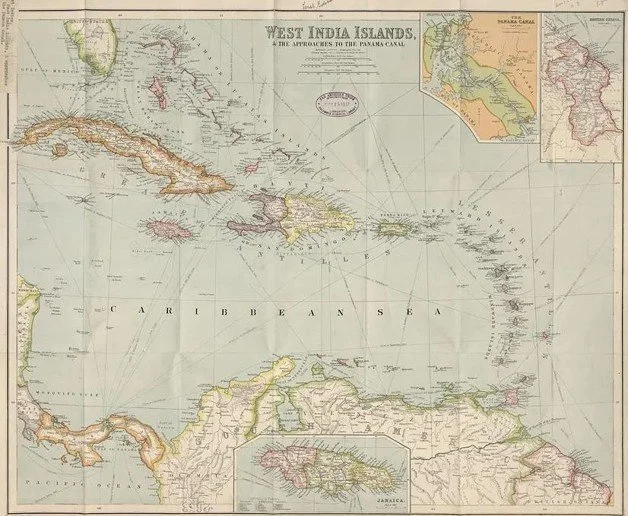
West India Islands and the Approaches to the Panama Canal, London: George Philip & Son Limited [1915 to 1917] from the Geography & Map Division, Library of Congress, Washington, D.C. https://hdl.loc.gov//wdl.11327. Public Domain.
The Dutch Caribbean Islands
Why are the three ABC islands in the Caribbean near Venezuela—Aruba, Bonaire, and Curaçao—and the three northeastern Caribbean islands—Sint Eustatius (often called Statia), Sint Maarten, and Saba—known as the Dutch Caribbean islands?
Our story begins with Queen Isabella of Castile and King Ferdinand of Aragon. They had five children who survived infancy, four girls and one boy. Isabella, John, Joanna, Maria, and Catherine.
Isabella and Ferdinand had greater ambitions than being limited to the Iberian Peninsula. They knew that the future of Castile and Aragon lay beyond the Pyrenees. Castile was looking westward across the Atlantic and Aragon eastward to the Mediterranean. The Crown of Aragon already ruled Naples on the Italian Peninsula, along with the island kingdoms of Sicily and Sardinia.
Isabella and Ferdinand cleverly began arranging marriages for their five children into strategic royal houses in Europe. They were building a network of alliances to protect both Castile’s Atlantic interests and Aragon’s Mediterranean possessions.
They arranged for their eldest, Isabella, to marry Afonso, the Portuguese heir. After only about eight months of marriage, Afonso died in a riding accident at the age of 16. Isabella and Ferdinand arranged for Isabella to marry Afonso’s uncle, Manuel, who subsequently became King Manuel I of Portugal.
After Isabella’s death in childbirth, Isabella and Ferdinand arranged for Isabella’s younger sister, Maria of Aragon, to marry King Manuel I. That marriage preserved the alliance between Portugal and the crowns of Castile and Aragon.
King Manuel and Queen Maria had ten children who survived infancy. John, Isabella, Beatrice, Louis, Ferdinand, Afonso, Henry, Edward, Anthony, and Maria.
Isabella and Ferdinand arranged for their youngest daughter, Catherine to marry Arthur Tudor, heir to his father, King Henry VII of England. Arthur died five months after their marriage from what some believed was the sweating sickness, leaving a young widow in a foreign land.
Ferdinand did not want Catherine to return to Castile. He and Isabella had paid only half of Catherine’s dowry and Henry VII had no intention of returning the dowry that had been paid. Ferdinand was not interested in paying the balance without assurances that his daughter would be married into Henry’s royal family.
Catherine was caught between her father and her former father-in-law and as instructed by her father, she stayed in England. Eventually, Henry VII died, and Arthur’s younger brother, Henry, became King Henry VIII. Canon law ordinarily prohibited a man from marrying his brother’s widow. So after obtaining a special dispensation from the Pope, Henry married Catherine, and she became Queen Catherine of England. The marriage preserved the alliance between England and the crowns of Castile and Aragon.
The marriages of John and Joanna introduced Maximilian, the King of the Romans, and his wife, Mary, the Duchess of Burgundy. They had a son and a daughter, Philip the Handsome and Margaret of Austria.
When Philip was four and Margaret was two, their mother died in a riding accident. Philip inherited the Burgundian Netherlands, which his mother had inherited from her father, Charles the Bold, the last Valois Duke of Burgundy. Philip’s father, Maximilian, ruled the Burgundian Netherlands as Philip’s regent until he came of age.
The Burgundian Netherlands, part of the region known as the Low Countries, consisted of a collection of wealthy provinces. These provinces, with booming textile cities and long-haul trade, were some of the richest in Europe. They encompassed what is now Belgium, the Netherlands, Luxembourg, and parts of northern France.
Much of their growing naval strength came from the maritime provinces of Holland and Zeeland, which border the North Sea. These provinces had long seafaring traditions and their own fleets and maritime traditions.
Philip and Margaret were raised at the Burgundian court, under the influence of their step-grandmother, Margaret of York. Margaret was the sister of two English kings, Edward IV and Richard III.
Isabella and Ferdinand and Maximilian entered into a double marriage alliance with Maximilian that would strengthen Castile and Aragon’s position against France and create the possibility that one day Maximilian and Mary’s descendants would inherit the crowns of Castile and Aragon.
Under the arrangement, Isabella and Ferdinand’s only son, John, Prince of Asturias, would marry Margaret of Austria. The Prince of Asturias was the heir apparent to the Crown of Castile. Isabella and Ferdinand’s daughter, Joanna, would marry Margaret’s older brother, Philip the Handsome.
Although the marriages were arranged as a double marriage, the actual ceremonies were about a year apart. By this time, Maximilian’s father, Frererkick III, Holy Roman Emperor, had died, leaving Maximilian to be elected Holy Roman Emperor.
When Joanna married Philip the Handsome, the House of Habsburg was brought to Castile by marriage, and Joanna became the Duchess of Burgundy. Philip and Joanna went on to have six children: Eleanor, Charles, Isabella, Ferdinand, Mary, and Catherine.
When Queen Isabella of Castile died in November of 1504, Joanna, Isabella’s oldest surviving child, became Queen of Castile.
At the time of her mother’s death, Joanna and Philip were living in the Burgundian Netherlands where he was ruling as Duke of Burgundy. The Burgundian court in the Low Countries was a traveling court, although predominantly based in Brussels.
In Joanna’s absence, her father, Ferdinand, continued to govern Castile. In anticipation of her return to Castile, he began claiming that she was mentally unfit to rule.
By the time Joanna and Philip arrived in Castile in the spring of 1506, many of the Castilian nobles, seeking to reduce Ferdinand's influence, had turned against him, and they now favored his son-in-law. Philip forced Ferdinand aside, and the Castilian nobility recognized him as King Philip I of Castile.
Tragedy struck a few months later when Philip died. Some believed he had been poisoned by his father-in-law, but there was never any proof.
Philip’s death put two important events in motion. First, Ferdinand returned to govern Castile on behalf of his daughter, Queen Joanna. And second, Philip and Joanna’s six-year old son, Charles, became Lord of the Netherlands. That made him the ruler of the Low Countries. His Aunt Margaret of Austria, the widow of his uncle John, Prince of Asturias, served as his regent.
Ferdinand died in 1516 and Joanna succeeded him as Queen of the Crown of Aragon, which included the Italian possessions of Naples, Sicily, and Sardinia. zdFerdinand had provided that because she was mentally unable to rule, her son, Charles (r. 1516-1555), would rule with her, although she never exercised her right to rule. She was confined to Tordesillas.
In 1517, Charles arrived in Castile from Brussels with a large entourage of nobles and clerics. Charles had been raised in the Netherlands with little knowledge of the country he was to be ruling. Many Castilians saw him as a foreigner.
As Castile was dealing with the change of monarchs, Western Europe, which had long been united under the Roman Catholic Church, was soon to change. Within weeks of Charles’s arrival in Castile, a priest in Germany named Martin Luther posted his Ninety-Five Theses on a church door in Wittenberg, Germany. Although Luther did not intend to break from the Catholic church, a break would soon occur. And so began the Protestant Reformation.
In 1518, the Cortes at Valladolid recognized Charles as king of Castile, jointly with his mother. The Cortes also granted Charles the right to collect an additional tax.
The next year, 1519, three years after Ferdinand’s death, Charles’s other grandfather, Maximilian, Holy Roman Emperor, died. Charles was elected Holy Roman Emperor. At nineteen, Charles’s titles included King of Castile and Aragon, Archduke of Austria, ruler of the Burgundian Netherlands, and Holy Roman Emperor.
Inheriting the Crowns of Castile and Aragon, as well as the Burgundian Netherlands, was very difficult for Charles. He was suddenly ruling vast territories with his mother, whom he scarcely knew, and who was confined in Tordesillas.
In 1520, Charles was now Holy Roman Emperor, and he asked the Cortes for a large grant to handle his new financial duties. The Cortes approved and Charles, after appointing Dutch cardinal Adrian of Utrecht as his deputy, left for Germany.
The citizens of Castile wondered why they were paying higher taxes to finance a foreign king’s European ambitions. They rose up against his rule and his administration.
As the riots were taking place in Castile, Pope Leo X was ordering Martin Luther to recant his teachings, which the Church condemned. Luther refused and was excommunicated.
Charles convened the Diet of Worms (diet meaning “assembly,” and Worms—pronounced Vormss—being a city in Germany), where he also demanded Luther recant. When Luther refused, Charles declared Luther an outlaw. After the Diet, the divisions among the German princes widened. Some backed Charles and the Church, others Martin Luther. What began as a theological rift became a political struggle.
Quite soon after Martin Luther’s challenge to the church, Lutheran ideas began entering the Dutch provinces through merchants, printers, and students. Anabaptists also became influential, especially among artisans and townspeople. The change occurred gradually.
Meanwhile in Castile, the rioters controlled the cities of Valladolid, Tordesillas, and Toledo. But after nearly a year of rebellion, the supporters of Charles defeated the Comuneros at the Battle of Villalar. This victory crushed the uprising and strengthened royal authority in Castile. The rebellion became known as the Revolt of the Comuneros.
Charles realized that his vast holdings were more than he alone could rule. In 1521, he entrusted his brother Ferdinand with the Austrian hereditary lands.
In 1526, Charles married his first cousin, Isabella of Portugal. She was the daughter of King Manuel I and Maria of Aragon, Charles’s mother's younger sister. Isabella of Portugal was now Queen of Castile and Aragon and Holy Roman Empress. When Charles was away from Castile, he relied heavily on Isabella as his regent. She proved to be effective and capable.
In 1531, Ferdinand was elected King of the Romans. That set him up as Charles’s successor as Holy Roman Emperor.
In 1533, Pedro de Heredia, a conquistador acting under the authority of the Crown of Castile, founded Cartagena de Indias on the Caribbean coast of present-day Colombia. Cartagena quickly became one of Castile’s major Caribbean ports. It grew into a hub for commerce and the slave trade, and a key gathering point for Castile’s treasure fleets.
Meanwhile in England, King Henry VIII was adding to Charles’s grief by replacing Charles’s aunt Catherine with Anne Boleyn. Henry was unable to receive an annulment from his marriage to Catherine, so he broke England from the Catholic Church and had England develop the Church of England as its official state church.
In 1536, John Calvin published the first edition of his Institutes of the Christian Religion. The Calvinist movement followed the Lutheran movement. In France, the Calvinists were called Huguenots.
The popes expected Charles to defend the church and stamp out heresy. But Charles was consumed with the Protestant Reformation, French incursions into the Burgundian Netherlands and his Italian kingdoms, an Ottoman army that had made its way to Vienna and its fleets sailing the Mediterranean, his own army that went rogue and sacked Rome, and his Aunt Catherine’s marriage difficulties costing the Catholic Church England.
After Charles’s wife’s death in 1539, he relied on the Council of Castile and trusted nobles as caretaker. In 1543, his son Philip became his father’s regent for the Crowns of Castile and Aragon.
Calvinism was beginning to replace Lutheranism as the most important Protestant movement in the provinces. It developed underground congregations despite severe persecution by Emperor Charles V and Philip II.
Enormous silver deposits were discovered in Potosi, in the Viceroyalty of Peru, in 1545. The silver was smelted at the mines and made into ingots and coins. They were shipped up the South Sea to Panama City, and then carried by mule train across the isthmus to Nombre de Dios, the Caribbean terminal, before being shipped to Castile. Silver was making Castile rich.
In 1555, Charles concluded the Peace of Augsburg between the Holy Roman Empire and the Lutheran princes. Each German prince now could establish whether his territory would be Catholic or Lutheran.
By 1555, Charles had been ruling for almost four decades. He was simply worn out. His mother’s death that year ended their co-sovereignty. He was now the sole ruler of the Crowns of Castile and Aragon, the Burgundian Netherlands, and the Castilian possessions in the Caribbean.
Charles surrendered the Austrian Habsburg lands and the imperial succession to Ferdinand. He also gave the Crowns of Castile and Aragon, the Lordship of the Low Countries, and the Americas to his son, who became Philip II (r. 1556-1598). He then retired to a monastery in Castile and died three years later.
This split formalized the two branches of Habsburgs, the Austrian Habsburg to Ferdinand and the Spanish Habsburg to Philip II.
Through his reign, Charles had planted the seed of trouble with the Dutch provinces through higher taxes, centralization of government, and religious persecution of non-Catholics, but what was to come was the rigidity of his son, Philip II, and that sparked the fire.
In the 1560s, tensions grew over heavy taxation to fund Castile’s wars, Philip’s government’s asserting tighter control over the provinces, and his attempts to suppress growing Protestantism that was replacing Catholic orthodoxy.
In August 1566, widespread resistance to Philip’s rule erupted in Flanders and rapidly spread across the seventeen Dutch provinces. It took on the name Iconoclastic Fury. The religious idea behind the “image storm” was that many Calvinists believed Catholic statutes and images encouraged idolatry. Groups of Protestants in the Low Countries began breaking into Catholic churches and destroying religious images, statutes, paintings, altars, and stained glass.
Philip regarded the destruction as heresy and rebellion. He sent the Duke of Alba to the provinces to restore royal authority and to punish the offenders. Alba’s harsh repression helped push the conflict toward the full-scale revolution that began the next year when William the Silent, Prince of Orange, led an armed rebellion. This began the Dutch Revolt and the Eighty Years’ War (1568-1648).
In 1578, back on the Iberian Peninsula, Portugal went through a dynastic crisis. King Sebastian of Portugal, who was childless, took an army to North Africa and did not return. His great uncle, Henry, now a cardinal, became king of Portugal.
In 1579, the seven northern provinces, Holland, Zeeland, Utrecht, Gelderland, Overijssel, Friesland, and Groningen, united in the Union of Utrecht. Several southern provinces reconciled with Philip, while others were subsequently reconquered and remained under Habsburg rule.
After the Union of Utrecht, the northern Netherlands became predominantly Protestant politically, although many inhabitants remained Catholic.
When King Henry died in 1580 without heirs, Philip pressed his claim to the Portuguese throne through his mother, Isabella of Portugal. An army commanded by the Duke of Alba entered Portugal, and Philip claimed the Portuguese throne. Philip II now ruled Castile, Aragon, and Portugal with their overseas empires, including Castilian territories in the Caribbean and the Philippines, as well as Portugal’s empire in Africa, Asia, and Brazil.
Once Portugal and Castile shared a monarch, the Dutch access to Portuguese trade became increasingly restrictive. They could no longer buy spices through Lisbon or enslaved Africans through Portuguese ports on the West African coast.
In 1581, the seven northern provinces issued the Act of Abjuration, formally rejecting Philip II’s sovereignty. The Dutch Reformed Church became the privileged public church. The southern provinces, roughly modern Belgium, remained largely Catholic.
Seven years later, 1588, the seven northern provinces decided to govern themselves through the States General and to operate as the Dutch Republic, also known as the Republic of the Seven United Netherlands, or the United Provinces.
In 1596, Nombre de Dios, the Panamanian port on the Caribbean, was abandoned in favor of Portobello. Nombre de Dios had become too difficult to defend from attacks by English privateers, including Francis Drake.
In 1598, Philip II died, and he was succeeded by his son, who became Philip III (r. 1598-1621). The next year Philip married Margaret of Austria.
In 1602, the Dutch Republic created the Dutch East India Company for operations in Asia. The DEIC combined commercial, colonization, privateering, and warfare by building its own trading and naval power.
In 1621, Philip III died, and he was succeeded by his son, who became Philip IV (r. 1621-1665).
After over 125 years of Castilian dominance in the West Indies, the 1620s saw the English and the French begin settling some of the lightly defended islands in the Lesser Antilles. This opened the door for the Dutch, who were looking for ways to weaken Castile’s empire.
In 1621, the Dutch Republic created the West India Company for the Atlantic. In the early 1630s, the WIC began seizing lightly guarded islands in the Lesser Antilles. It seized the northeastern islands of Sint Eustatius (often called Statia), Sint Maarten, and Saba. These islands were about trade and not about Castilian shipping lanes.
Then in 1634, the WIC seized Curaçao, and in 1636, Aruba and Bonaire. These “ABC” islands were on the trade route to and from Cartagena, allowing the Dutch to intercept Castilian shipping and weaken Castile’s hold on Caribbean trade.
The islands offered access to trade—often illegal trade—along the Venezuelan coast. Curaçao became the most important of the three because of its excellent natural harbor, making it valuable as a privateering and commercial base near the Spanish Main.
It was not until 1648, over a dozen years after the WIC seized the six Caribbean islands, that Castile formally recognized the independence of the seven provinces in the Peace of Munster.
But the damage was already done. The three northeastern Caribbean islands—Sint Eustatius (aka Statia), Sint Maarten, and Saba, along with the three ABC islands, Aruba, Bonaire, and Curaçao—would remain Dutch.
maf
August 29, 2026
Martin A. Frey, Professor Emeritus
The University of Tulsa College of Law
© 2026 Martin A. Frey, All Rights Reserved.
Educational use permitted with attribution.